
 3 months ago
56
3 months ago
56
Antonio Conte made a bold claim after Napoli’s win over Cremonese about his squad versus that of his rivals, and naturally some reaction has followed.
Calcio e Finanza recall what he said: “For many reasons, because in my view we just started this journey. Our infrastructure isn’t ready, I feel Juventus, Inter and Milan have the structure, strength in depth and wage bills that are above all the other clubs.
“Every time someone other than that group wins a trophy, it means something truly extraordinary has happened. We mustn’t bury our heads in the sand and act like we are on the same level as these clubs.
“We try to bridge the gap as much as possible with hard work and dedication, but we cannot ignore that gap exists.”
Is Conte right? Squad costs compared
Conte discussed wages and squad value. The cost of a squad is certainly useful for understanding the investments a club has made in its player pool and, consequently, understanding who is willing to go all the way in the competitions they participate in.
Calcio e Finanza have updated the analysis already conducted after the summer transfer window closed, using official data from the financial statements ending June 2025 (which were not yet available in September).
Before delving into the numbers and specifics of each club, it’s worth remembering that Calcio e Finanza’s analysis of squad costs is conducted by taking the following players into consideration:
➤ Players owned by the club, taking into account the amortization quota and gross salary (and considering the tax breaks provided by the Growth Decree for the players who still benefit from them)
players who arrive on a temporary basis, for which the cost of the loan and the gross salary are taken into account.
➤ Club-owned players who are temporarily sold, for which only the amortisation portion is considered (and the salary only if paid by the club, since it is normally covered by the purchasing company)
The sum of these items for each player provides an idea of the cost each club incurs for its squad. To arrive at the final result, we used data from official press releases and club financial statements (primarily regarding players’ residual values) and salary rumours reported by major media outlets.

Milan not on the podium
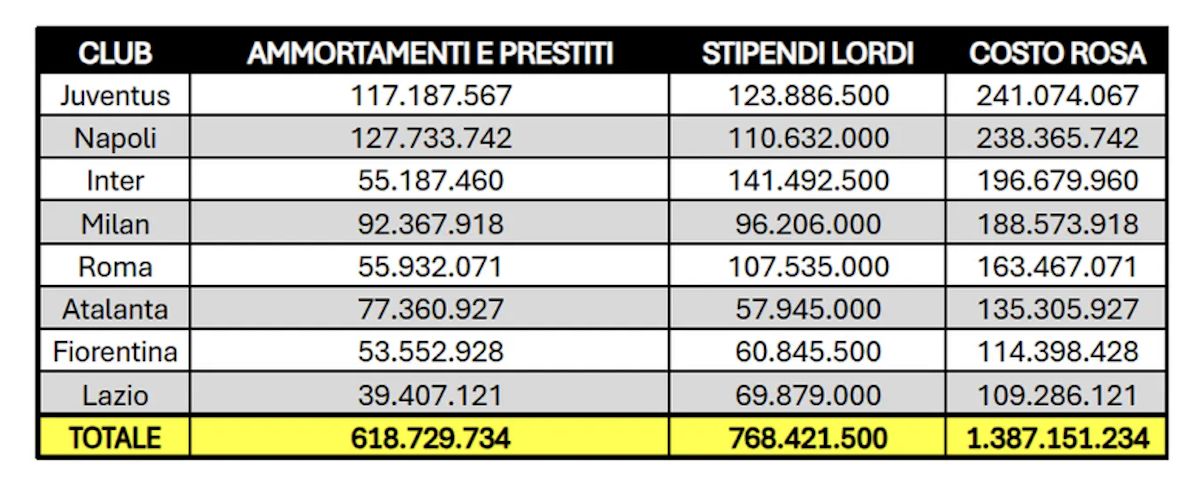
Looking at the numbers, we see that Juventus boast the highest squad cost among the big clubs. The Bianconeri’s figure has remained essentially stable compared to 2024-25, but the lead they’ve held for many seasons is now threatened by Napoli, who are just shy of the Piedmontese club.
Second place is occupied by Napoli. The last two summers – both in the Conte era – have weighed heavily on the Neapolitans’ accounts. Their unique system of decreasing-rate amortisation of player rights (with a higher cost charged to the budget in the first two years of a contract) means that particularly expensive transfers significantly increase the squad cost.
On the other hand, it’s worth noting that amortisation rates consequently decrease the following year, an effect that partially offsets the increases.
Calcio e Finanza also simulated the cost of the squad without considering the declining-rate amortisation system. The resulting figure is clearly lower than this ranking, but well over €200m and would still place Napoli second among the top clubs in the league.
Inter complete the podium at €196m, surpassing – by a few million euros – their rivals Milan. The Oaktree-owned club are actually sixth in terms of amortisation, but top in terms of wages at €141m in net salaries.
Milan, on the other hand, have a substantial balance between depreciation and salaries, unlike the Nerazzurri’s figures. This is because Milan has opted for a more conservative wage policy, but has invested heavily in player registrations in recent transfer windows.
Interestingly, Calcio e Finanza reported back in September that the Rossoneri would have a higher squad cost than their city rivals, but this has now been adjusted with the new information from accounts.






 English (US) ·