
 2 months ago
47
2 months ago
47
It did not take AC Milan long to announce their first signing of the January window, with Niclas Füllkrug the player to arrive.
After weeks of rumours about ongoing interest and positive talks, Milan confirmed the signing of Füllkrug on an initial loan deal from West Ham United just hours after the window had officially opened on January 2.
In actual fact, the striker had been training at Milanello with his new teammates since Boxing Day, thanks to the clearance granted by the London club. The aim was to have him ready for Massimiliano Allegri for the match against Cagliari, and he did indeed make the squad.
Not only that, but we got a cameo from the German off the bench, and he grew into the game after a rusty start. What can fans expect from a player many West Ham fans were happy to see the back of?
Back story
Niclas Füllkrug was born in Hanover on 9 February 1993 in Hanover, Germany. He played for a number of different local sides including TuS Ricklingen – where he spent eight years from 1996 to 2005 – and then Sportfreunde Ricklingen for one year.
It is believed that while with the former he averages 160 goals per season playing at various youth levels, showing how dominant he was from a young age. This attracted the attention of Werder Bremen, and he joined their academy aged 14.
By 2011 as an 18-year-old he was playing at full senior level with Werder Bremen II, and then two years later he headed to Greuther Fürth on a one-year loan deal. In November 2013 he announced himself to everyone with a 12-minute hat-trick against Erzgebirge Aue in an eventual four-goal haul.
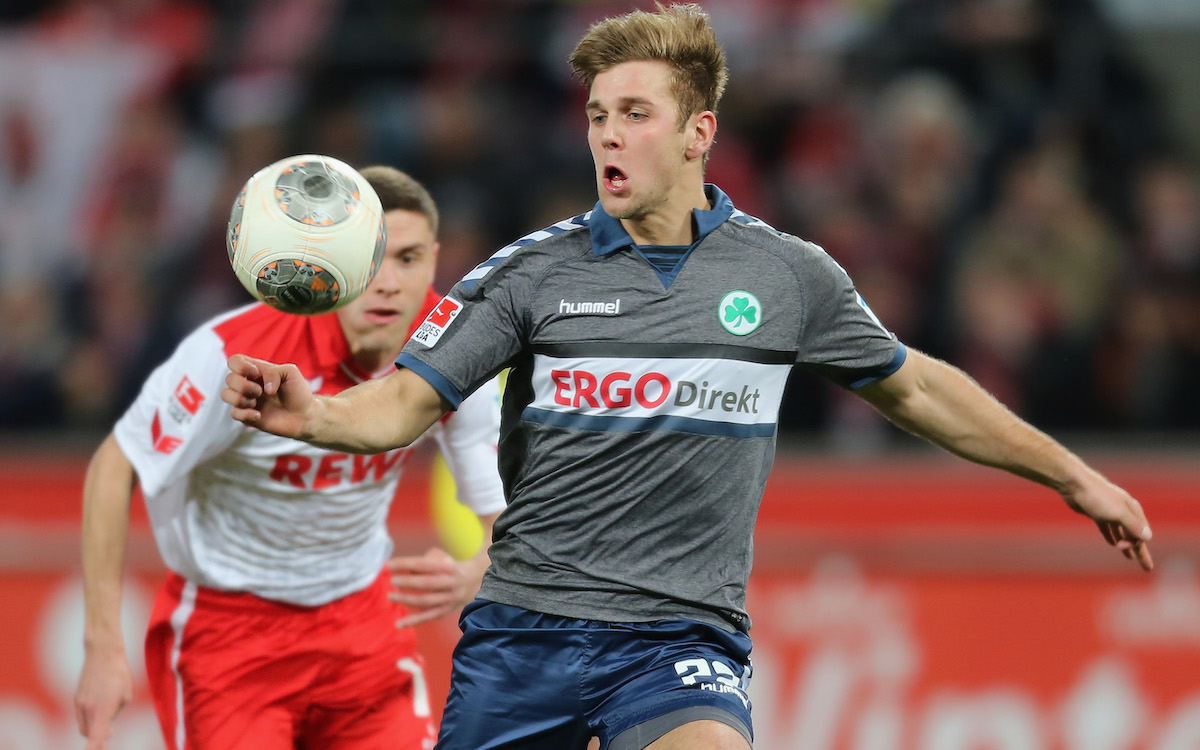
Injury setbacks would sadly become a theme running through his career, and he sustained a ligament rupture in his right ankle after a great start with Fürth. After he recovered, he joined their city rivals Nürnberg permanently, but Werder had a buy-back clause.
After bagging 18 goals in 59 appearances for them across two competitions Füllkrug joined his hometown club Hannover 96 on a four-year deal in July 2016, for a fee reportedly worth €3m including bonuses. He failed to score in his first eight Bundesliga games, and then he took off.
The striker bagged a hat-trick against Mainz 05 on 13 January 2018 and ended with 14 goals in his first season, earning talk of a potential call-up to the German national team. It is worth mentioning at this point that he was only 25.
He could have made a big-money move to Borussia Mönchengladbach that summer as they apparently offered €18m to sign him. Füllkrug stayed and renewed his deal, but the next season was plagued by an ankle issue and various knee problems, including cartilage damage to his right knee for the third time in his career.
After an operation, Füllkrug went back to former club Werder Bremen in the 2019 summer window for around €6.3-7m, depending on which source you believe. He would sustain another knee issue that September and miss several months, scoring four goals in 11 games that season.
Bremen suffered relegation in 2020-21, but Füllkrug did bag his first top-flight hat-trick against Schalke. New signing Marvin Ducksch came in, the pair were used together and Niclas bagged 19 goals in the 2. Bundesliga to secure an instant return to the first division.
Then, Füllkrug’s exploits continued. In the first 14 games of the 2022–23 Bundesliga season he bagged 10 goals, convincing Germany national coach Hansi Flick to call him up for the World Cup in November. He was the league top scorer that season with 16 goals, tied with none other than RB Leipzig’s Christopher Nkunku.
😮 In 2022-23, Füllkrug and Nkunku were competing for the Bundesliga golden boot.
⏩ Now both are at #ACMilan, and without a league goal this season. pic.twitter.com/7gmlRxqZLM
— SempreMilan (@SempreMilanCom) December 27, 2025
Then came the next step, as the forward headed to Borussia Dortmund for a fee of around €13m plus bonuses. It was far from a bad season for him as he got 25 goal contributions (15 of them goals) in 43 games across all competitions, including another hat-trick.
He scored his first Champions League goal in a 2-0 victory over Newcastle United. Further goals in the competition came against Atlético Madrid and Paris Saint-Germain. He scored a header ruled-out by the VAR in a 2-0 loss to Real Madrid in the final.
The Premier League came knocking with its riches, and the German headed to West Ham United for a reported fee of €30m, signing a four-year deal. He scored just three goals in 18 months there, in another injury-plagued spell in his career.
As mentioned, Füllkrug’s first senior national team call-up came in November 2022, for the World Cup in Qatar. He scored on his debut against Oman in a friendly, and then scored in the tournament itself in a 1-1 draw with Spain, adding another goal in a 4–2 win over Costa Rica. However, Germany finished third in the group and went home early.
The 32-year-old has scored 14 goals in 24 games for his country, which is far from a bad record. However, due to various ailments, he has not played for Germany since June, which puts his spot at the 2026 World Cup in a bit of doubt.
Strengths and weaknesses
In his analysis, Rohit Rajeev has broken Füllkrug’s profile down into various different areas to deduce exactly what Milan might get from such an enigmatic yet traditional centre-forward.
Physiological: Füllkrug fits the mesomorph profile of what Milan need. A high muscle-to-fat ratio, strong frame, and long legs mean short-to-medium strides, which could partly explain his recurring injuries.
He isn’t a high top-speed striker, but his acceleration over short distances is solid, making him effective in the box and in duels rather than in open-field sprints.
Psychological: Füllkrug is a vocal presenc. He is very different from Christian Pulisic’s quieter leadership style. You can often see him taking charge in huddles, like during West Ham’s game against Chelsea.
PSYCHOLOGICAL
Füllkrug is a vocal presence 🗣️⚽ — very different from Pulisic’s quieter leadership style. You can often see him taking charge in huddles, like during West Ham’s game against Chelsea.
He may not be in the mould of Zlatan or Giroud, but a striker who demands the… pic.twitter.com/BvFcp86DbG
— Rohit Rajeev (@keralista) January 1, 2026
He may not be in the mould of Zlatan Ibrahimovic or Olivier Giroud, but a striker who demands the ball, shows for it, and communicates constantly is a big plus for Milan, especially for structure, confidence and game management in tight moments.
On the ball
Starting position: Typically, Füllkrug starts deeper than most forwards, which allows Dortmund to play directly into him . This positioning enables him to operate with his back to goal, hold-up play, and link attacks while other forwards make runs in behind, making him an ideal reference point in the final third.
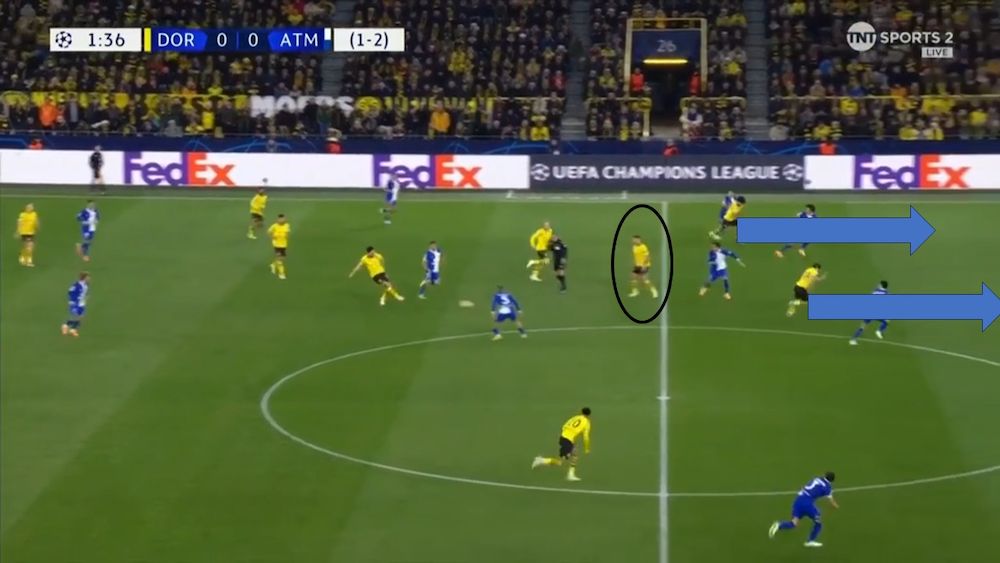
First touch: Füllkrug usually prefers to receive the ball with the instep of his boot, but his first touch isn’t consistently clean, and that inconsistency has been a recurring weakness in his game.
First touch
Füllkrug usually prefers to receive the ball with the instep of his boot ⚽, but his first touch isn’t consistently clean, and that inconsistency has been a recurring weakness in his game. pic.twitter.com/tYQlKbP77p
— Rohit Rajeev (@keralista) January 1, 2026
Dribbling: Füllkrug is a low-touch striker who occasionally uses his left foot to dribble past markers, but not with consistency. At Dortmund, Terzić streamlined his role, using him primarily as a reference point to anchor the attack and link play.
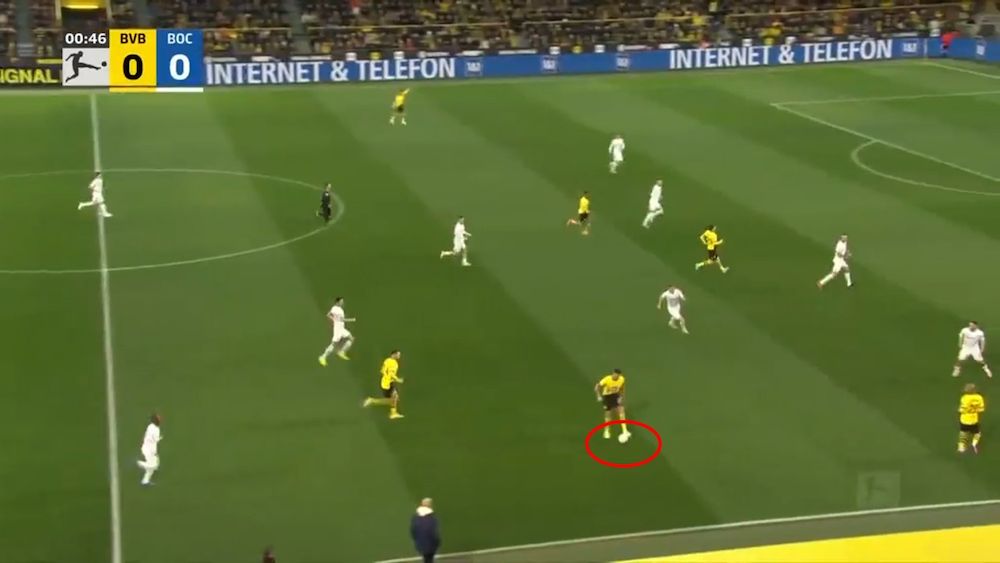
Link-up play: The German looks to connect play through varied passing choices. He often releases team-mates with minimal touches, prioritising ball progression and finding runners in pockets of space. Quick, deft touches are also used effectively for flick-ons and sharp combinations.
Hold-up play: Füllkrug uses his frame intelligently to place his body between the ball and the opponent, effectively shielding possession. He executed this perfectly against Axel Witsel, holding his ground long enough to allow Ian Maatsen to get his shot off against Atlético Madrid.
Striker instincts: In this sequence you can clearly see Füllkrug’s striker instincts, delaying his run, then bending it to attack the space at the exact moment the cross is delivered. He consistently targets the far post on crosses, timing his movement to arrive unmarked and maximise his finishing angles.
Strikers instincts
In this sequence you can clearly see Füllkrug’s striker instincts 🧠⚽ — delaying his run, then bending it to attack the space at the exact moment the cross is delivered 🎯. He consistently targets the far post on crosses, timing his movement to arrive… pic.twitter.com/uBidHReAst
— Rohit Rajeev (@keralista) January 1, 2026
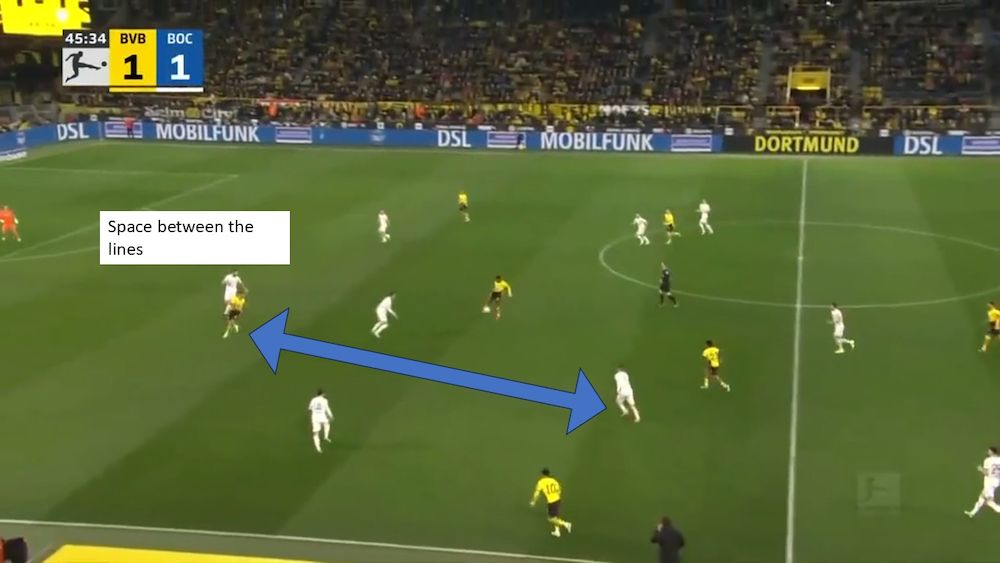
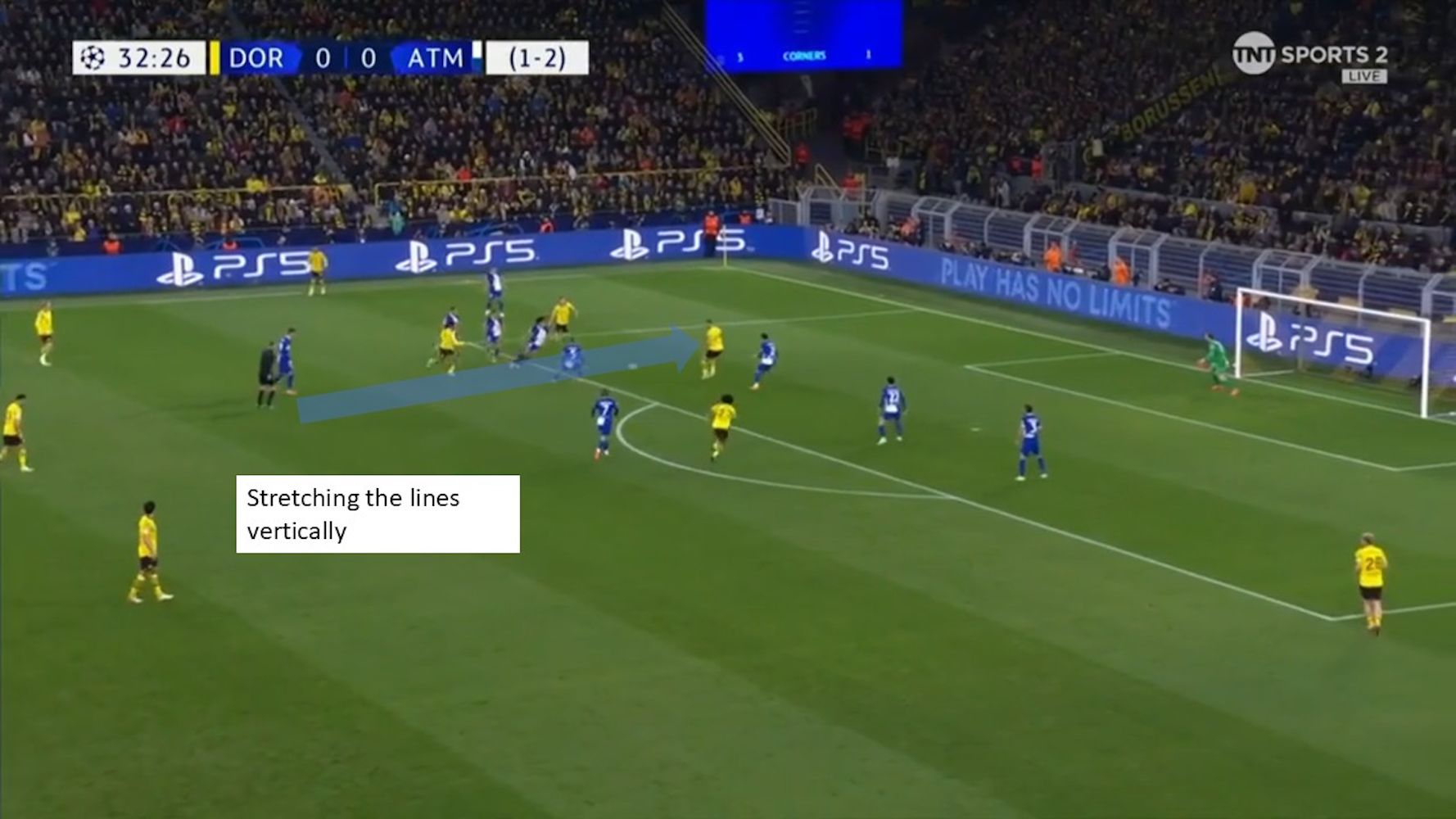
Off-ball movements: Füllkrug mainly stretches play vertically by playing on the shoulder of the last defender. Here we can see him pinning the defender positionally creating space between the lines. Another example is where he takes a position in the box thereby stretching the last line of defence.
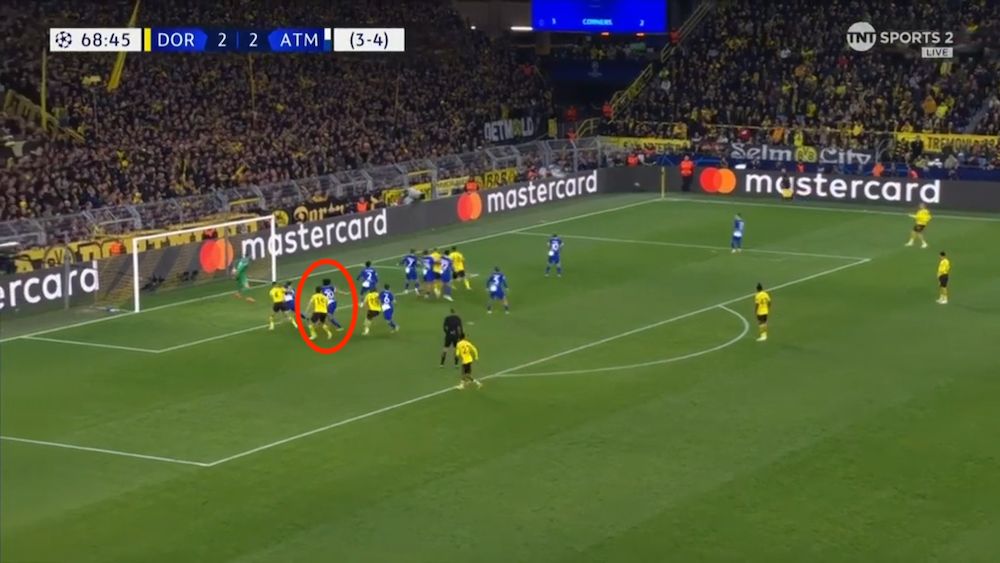
Set-piece threat: The ex-Hannover man is naturally a major set-piece threat due to his aerial ability. At Dortmund, he regularly attacked the far post under Terzić’s setup, using his height and timing to win first contact and generate flick-ons, a clear, repeatable weapon in dead-ball situations.
Shooting technique: Füllkrug employs a variety of shooting techniques. His strongest weapon is unquestionably his heading ability, while he also attempts finishes using the instep drive and the toe-punt. However, the success rate of these latter techniques tends to vary, reflecting some inconsistency in his overall finishing profile.
Shooting technique
Füllkrug employs a variety of shooting techniques 🎯⚽. His strongest weapon is unquestionably his heading ability, while he also attempts finishes using the instep drive and the toe-punt. However, the success rate of these latter techniques tends to vary,… pic.twitter.com/RuIqb5V5s6
— Rohit Rajeev (@keralista) January 1, 2026
Off the ball
Counter-pressing: Under Terzić, Dortmund adopted an intense pressing model, with immediate counter-pressing as a key principle after losing possession.
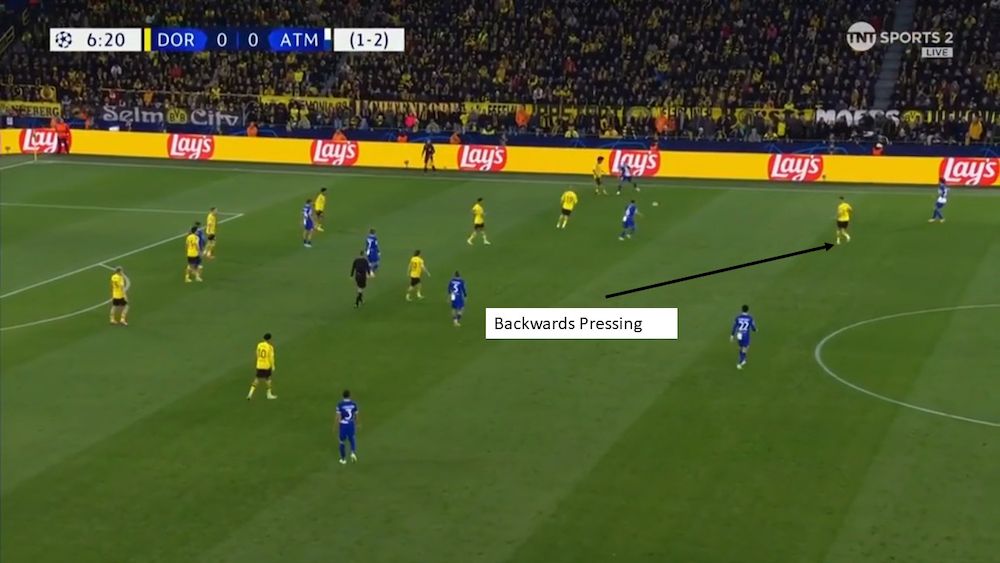
Füllkrug plays an important role here: using his sharp acceleration, he reacts quickly to engage the ball carrier. In this sequence, after Atlético regain possession, Füllkrug instantly counter-presses, blocks the vertical passing lane, and forces play backwards.
OFF THE BALL
Under Terzić, Dortmund adopted an intense pressing model, with immediate counter-pressing as a key principle after losing possession 🔄⚡. Füllkrug plays an important role here: using his sharp acceleration, he reacts quickly to engage the ball carrier. In this… pic.twitter.com/7LkZ0j0he8
— Rohit Rajeev (@keralista) January 1, 2026
He also specialises in backward pressing, intelligently cutting off the opponent’s retreating pass. This reduces the ball carrier’s options, traps them in narrow zones, and helps Dortmund regain territorial control rather than simply chasing the ball.
How does he fit Milan?
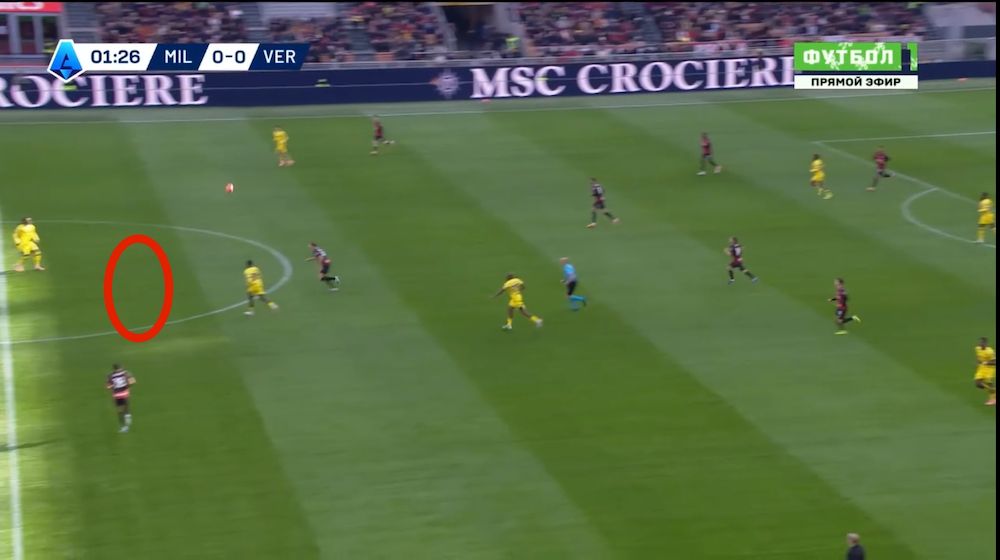
A simple example against Verona highlights a recurring issue. There is a clear ‘hole’ in the centre of the pitch where Maignan’s long ball is about to land, but neither Nkunku nor Pulisic (nor Leão) can occupy it effectively.
They simply lack the physical presence to duel with centre-backs and secure first contact, leaving Milan without a reference point to retain possession or sustain attacks.
With Milan statistically the worst high-pressing side in the league, signing Füllkrug could be a game-changer. His work rate and counter-pressing can help Milan press higher, slow opposition build-up, and delay vertical progression.
This is exactly why a profile like Füllkrug makes sense for Milan 🔑⚽
When you’re defending a slim lead, you need a striker who can relieve pressure, not just score goals. Just like Giroud vs Napoli — holding off Lobotka, winning the aerial duel, laying it off for Bennacer who… https://t.co/4VrWNfWmgb pic.twitter.com/DxGl1m398O
— Rohit Rajeev (@keralista) December 16, 2025
While defending 1-0 leads, Füllkrug can come on in the second half and hold the ball up from clearances and start counterattacks with his excellent back to goal approach.
Milan currently have the highest PPDA in Serie A — meaning the least intense high press in the league. 📊
Data from Opta (via FotMob) shows just how much things have changed under Allegri. The Scudetto-winning Milan of 2021/22 had the lowest PPDA and won the most possession in… https://t.co/Jq9Zz7Brm3 pic.twitter.com/NDjp53r8NR
— Rohit Rajeev (@keralista) November 6, 2025
Statistical comparison
In 2023-24, Dortmund recorded a long-ball completion rate of 62%, second only to Bayern Munich. A major reason was Füllkrug’s aerial efficiency, which stood at 58.7%, especially impactful in the Champions League.
Füllkrug is not a volume shooter. He averages around three shots per 90, with a G-xG of -0.5 and -0.6 across his last two seasons with Germany, indicating modest shot quality rather than high-volume finishing.
However, his value lies elsewhere. In terms of Goal Creating Actions, he posted 0.45 and 0.36 GCA per 90, underlining his role as a facilitator and reference point rather than a pure box finisher.
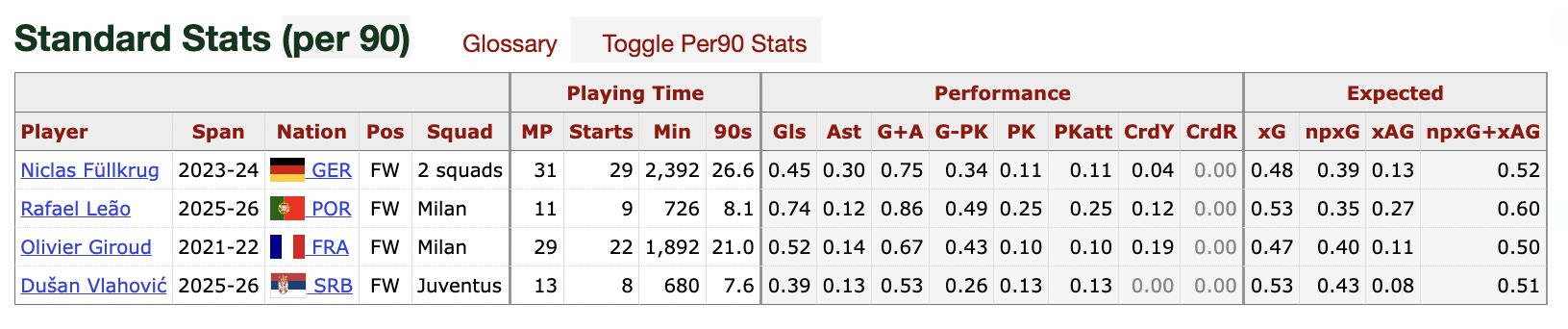
FBref provide an excellent player comparison tool which allows us to take a look at how Füllkrug stacks up (in 2023-24 at Dortmund, to give a big enough sample size) against other names close to Milan.
More specifically, Rafael Leao in 2025-26 (who has been the No.9), Olivier Giroud in the 2021-22 Scudetto season, and Dusan Vlahovic this season (who is believed to be the man Allegri wanted).
Füllkrug’s 0.45 goals per 90 has him third behind Giroud and Leao but ahead of Vlahovic. His assists at 0.3 per 90 are far higher than his rivals, though, leading to the second-best G+A per 90 number (0.75). His xG was 0.48 per game, suggesting he was taking the chances he got.
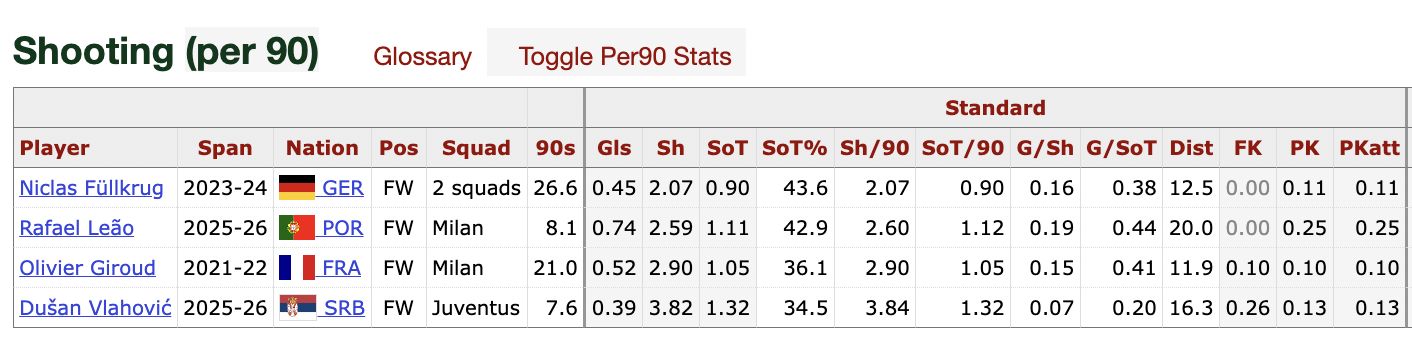
Füllkrug actually shoots the least at 2.07 attempts per 90, but his 0.9 shots on target gets him closer to the other three, by virtue of having the highest SOT% (43.6%).
His goals per shot ratio is 0.16, placing him above Giroud and Vlahovic, but below Leao, who has scored four times with his first shot on target this season.
Looking at average distance per shot, Füllkrug’s number is 12.5 yards per goal. Leao’s is remarkably 20, while Giroud is a bit closer and Vlahovic further away.
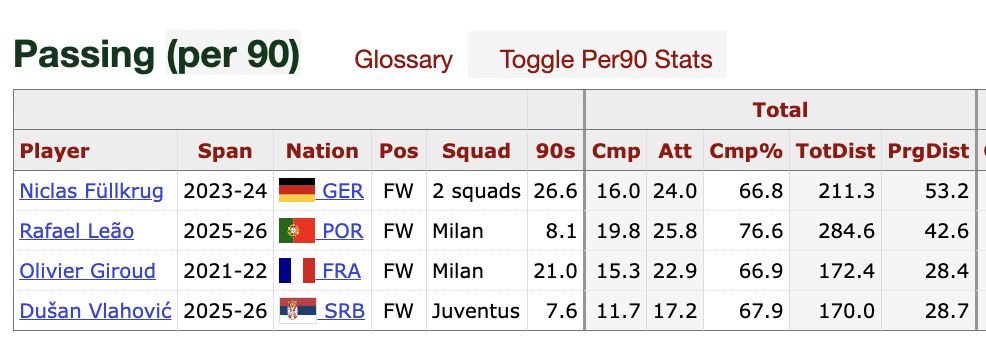
Finally the passing numbers. The German logged 16 completed passes per game in that season at Dortmund, higher than Giroud and Vlahovic but below Leao’s 19.8%.
His completion rate of 66.8% is significantly below Leao’s 76.6%, but is right in and around the numbers of Giroud and Vlahovic.
Interestingly, his Progressive Distance per game (the total distance in yards towards the opposition goal through passing) is by far the highest at 53.2, suggesting that he has comfortably the best hold-up and link-up play.
Transfer rating
Füllkrug’s abilities can be broken down into the following ratings: back to goal 8.5/10, hold-up play 8.5/10, strength 7/10, shooting (including headers) 7/10, passing 5/10, off the ball movements 6.5/10.
The nature of the deal is low-risk for Milan in the sense that there is very little financial commitment. However, it can also be argued that it is high-risk in the sense that the title hopes – however faint – may rest on someone who has really struggled for the last year and a half.
For us, this feels like a very simple equation: if the 32-year-old stays fit, he is likely to contribute with goals and to offer something different. If injuries follow him to Italy, this could fall into the Mario Mandzukic and Pietro Pellegri pile.
Final rating: 7/10

 English (US) ·